Overview & Pedagogical Objective
Most language learners repeat the same cues every day — a habit that feels productive but delivers diminishing returns. Spaced Repetition (SRS) solves this by scheduling reviews at precisely the moment your memory is about to fade, maximizing retention per minute of practice.
This platform uses the Leitner 5-Box System to track each dialogue cue independently. Every cue you practice is assigned to one of five boxes, each with a different review interval:
| Box | Review Interval | What it means |
|---|---|---|
| Box 1 | 1 day | Brand new or difficult — review daily |
| Box 2 | 3 days | Making progress — review every 3 days |
| Box 3 | 7 days | Consolidating — review weekly |
| Box 4 | 14 days | Near-mastered — review every two weeks |
| Box 5 | 30 days | Mastered — review monthly |
A cue starts in Box 1 the first time you record it. Each time you grade a take, the cue moves up, stays, or resets:
- Hard → resets to Box 1 (review tomorrow)
- Good → advances one box
- Mastered → jumps directly to Box 5 (review in 30 days)
Why Spacing Works: The Forgetting Curve
Before practicing, listen to the full connected-speech-stress-lab scenario once through in Continuous Mode. Pay attention to how liaison and elision patterns (*stand~up*, *bi[t] of*) create a continuous acoustic stream — not individual words.
Open the connected-speech-stress-lab scenario from the Scenarios catalog. Press Space to play in Continuous Mode. Listen without recording — this is your baseline acoustic exposure before graded review begins.
Hermann Ebbinghaus documented the Forgetting Curve in 1885: without review, humans forget ~50% of new material within an hour and ~70% within a day. Crucially, each successful spaced review extends the retention window — and shrinks the time cost of the next review.
For phonological memory (how sounds are encoded and reproduced), spaced retrieval practice has an additional benefit: each recall attempt forces your motor system to reconstruct the articulation pattern from the acoustic template, strengthening the neural pathway.
This is why the SRS Warmup phase comes first in every Daily Workout — re-activating existing cues before new learning is the highest-leverage move in your 15-minute session.
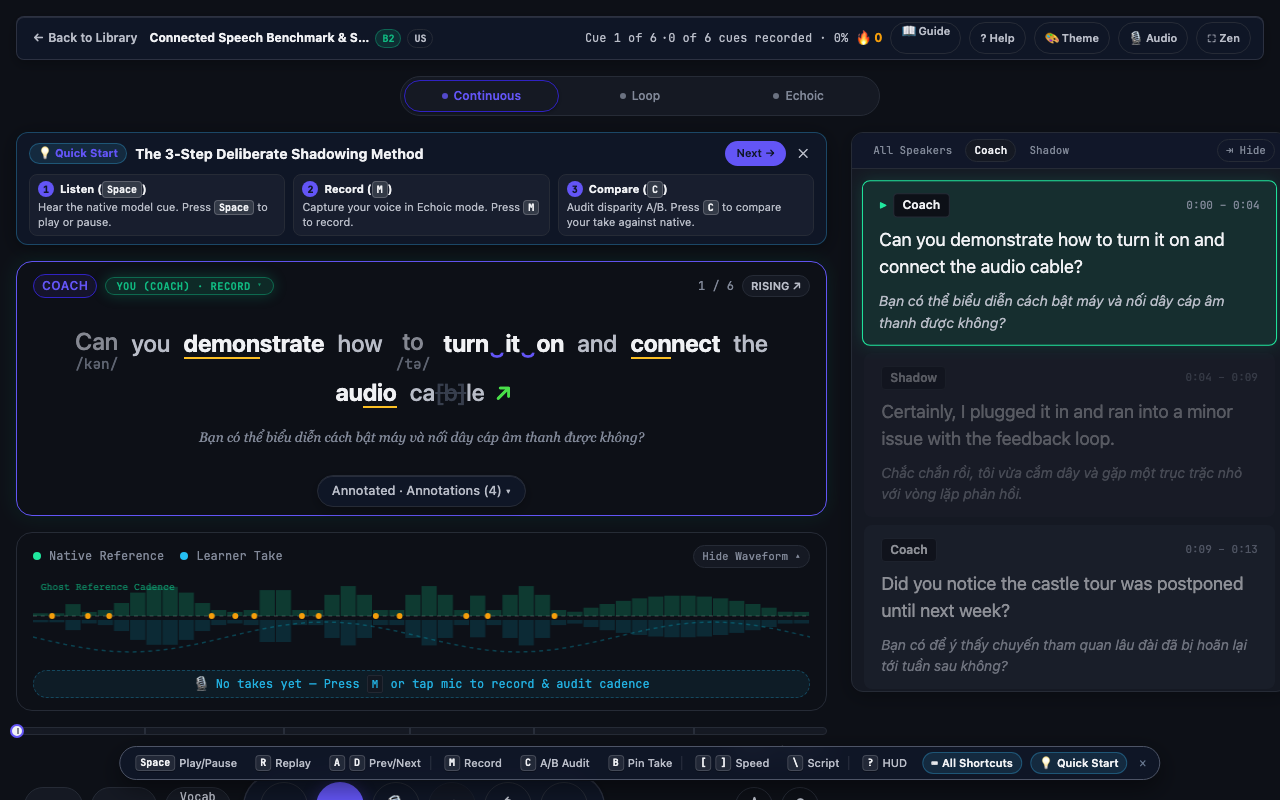
The first listen is never wasted. Your auditory cortex is building a phonological template against which all future takes will be compared. The cleaner this template, the more accurately you will detect disparity in your own recordings.
Skipping the passive listen and jumping straight to recording. Without a fresh acoustic template, your 'good' grade is based on a blurry memory rather than a sharp reference — and you will overgrade your own takes.
The 5-Box Progression: How Cues Move
Listen specifically for the *stress contrast* in each cue — which syllable carries the primary beat? In connected-speech-stress-lab, the connected speech patterns ('gonna', 'wanna', 'kinda') demonstrate how unstressed syllables compress under rhythmic pressure.
Switch to Echoic Mode (Tab) and record one take of the first due cue. After A/B comparison, grade the take using the three-button panel: Hard / Good / Mastered.
Each dialogue cue in your practice history has an independent Leitner state: a current box (1–5) and a next-review date.
When you grade a take after A/B comparison:
Hard — the cue resets to Box 1. Next review: tomorrow. Use this when your take misses the stress pattern, drops a linking boundary, or produces a clearly different intonation direction (↗ vs ↘).
Good — the cue advances one box. If it was in Box 2 (3-day interval), it moves to Box 3 (7-day interval). Use this when your take is broadly correct but not yet automatic — you had to think about the articulation.
Mastered — the cue jumps directly to Box 5 (30-day interval). Reserve this for takes where the phrase came out effortlessly, at natural speed, with no conscious monitoring of individual sounds.
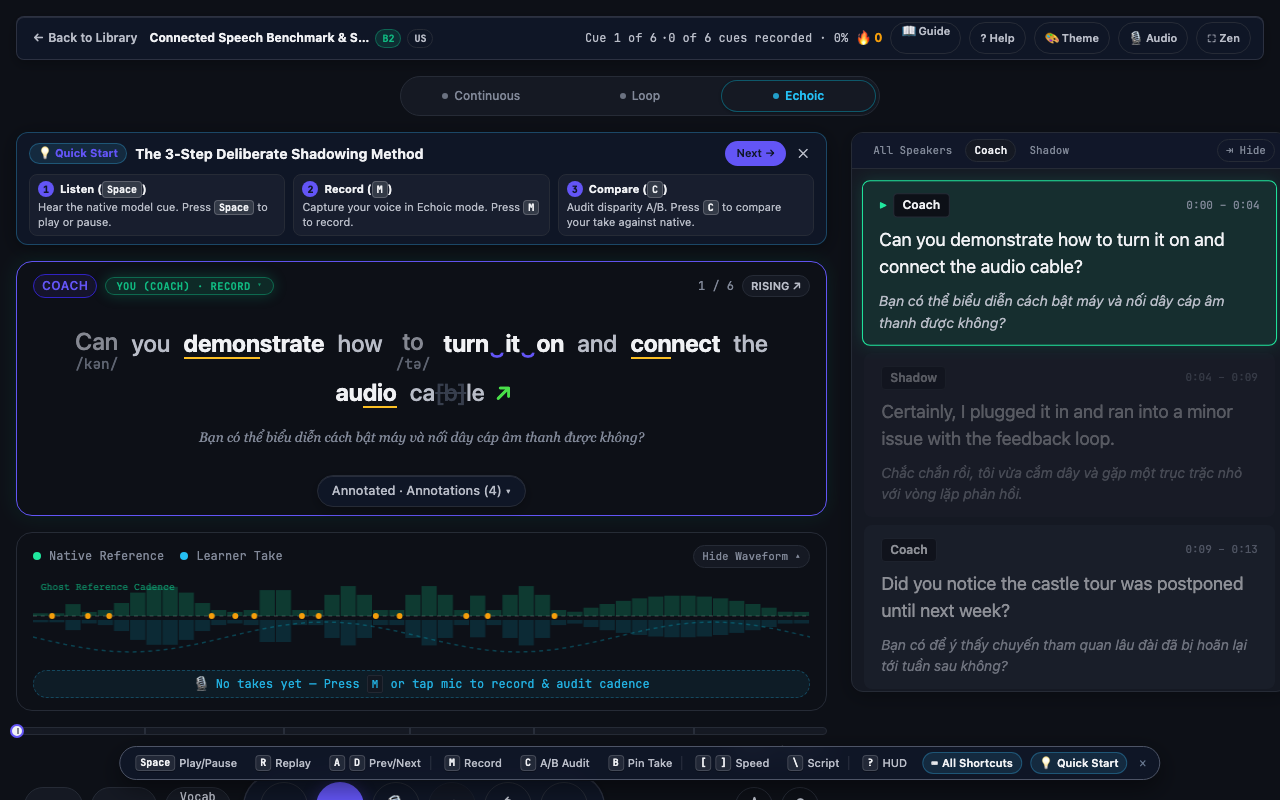
When in doubt, grade down. An over-generous 'Mastered' on a shaky take means you will not see that cue again for 30 days — and you will have lost the chance to consolidate it during the critical window.
Grading based on how the take *felt* rather than what you *heard* during A/B comparison. Subjective confidence is systematically biased toward over-rating. Let the waveform guide the grade.
Grading a Take: Hard / Good / Mastered in Practice
During A/B comparison, run three listening passes: (1) rhythm and pause placement, (2) intonation direction at phrase boundaries, (3) consonant linking and vowel reduction. Grade based on all three, not just the most salient difference.
After recording a take, press A to launch A/B Auditory Disparity comparison. Listen through the full sequence: Native Reference → 150ms silence → Your Take. Then select Hard, Good, or Mastered.
The grading panel appears immediately after the A/B Auditory Disparity comparison sequence ends. Three buttons are presented:
[ Hard ] [ Good ] [ Mastered ]Take your time with this decision — it is the most important input in the entire SRS system. The grade you give now determines when this cue surfaces again:
| Grade | Current Box | Next Box | Next Review |
|---|---|---|---|
| Hard | Any | Box 1 | Tomorrow |
| Good | Box 2 | Box 3 | In 7 days |
| Good | Box 4 | Box 5 | In 30 days |
| Mastered | Any | Box 5 | In 30 days |
After grading, the workstation automatically loads the next due cue. The SRS Warmup phase continues until either the 3-minute timer expires or the due queue is exhausted.
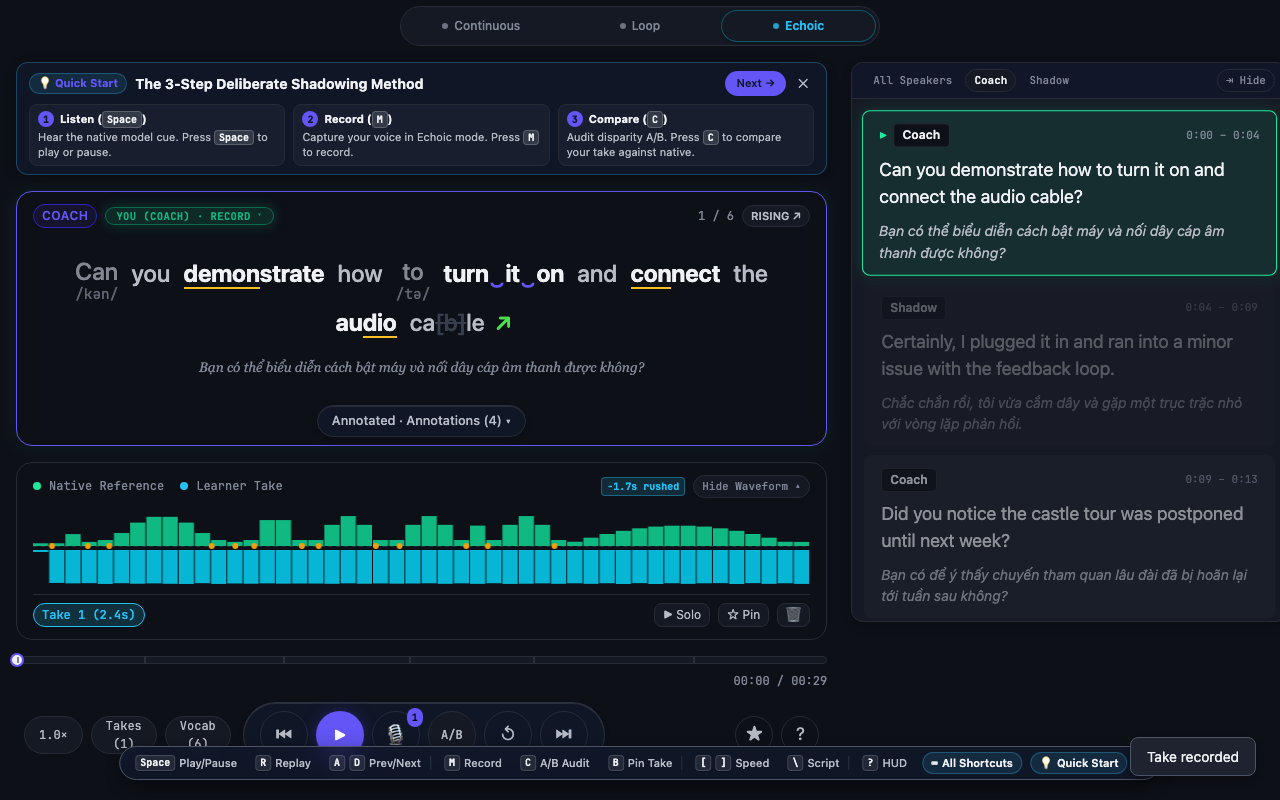
A reliable grading heuristic: if you can hear a specific difference in the A/B comparison, grade Hard or Good. If the two takes sound indistinguishable in rhythm, intonation direction, and linking — grade Mastered.
Comparing accent rather than prosody. A slightly different vowel quality (Australian vs American 'can't') does not warrant a Hard grade. Stress placement, linking boundaries, and intonation direction are the grading criteria.
How Due Cues Surface in the SRS Warmup Phase
When the warmup queue is short (< 3 cues due today), use the remaining warmup time to do a passive Continuous Mode listen of the full scenario. This acoustic re-exposure reinforces the phonological template before Core Rehearsal begins.
During the SRS Warmup phase, the cue ordering is managed automatically. You do not need to select cues manually. Simply respond to each cue as it loads: record, compare, grade. The system handles the rest.
At the start of each Daily Workout, the SRS planner selects today’s due cues by scanning your complete practice history and identifying every cue whose nextReviewDate is on or before today.
Cues are prioritized by:
- Overdue cues first — cues past their review date take highest priority.
- Box 1 cues next — recently failed cues are kept salient.
- Chronological order — within the same box, earliest-scheduled cues load first.
The warmup queue is capped to prevent cognitive overload during the warmup phase. Any cues beyond the cap are rescheduled to the following day’s warmup automatically.
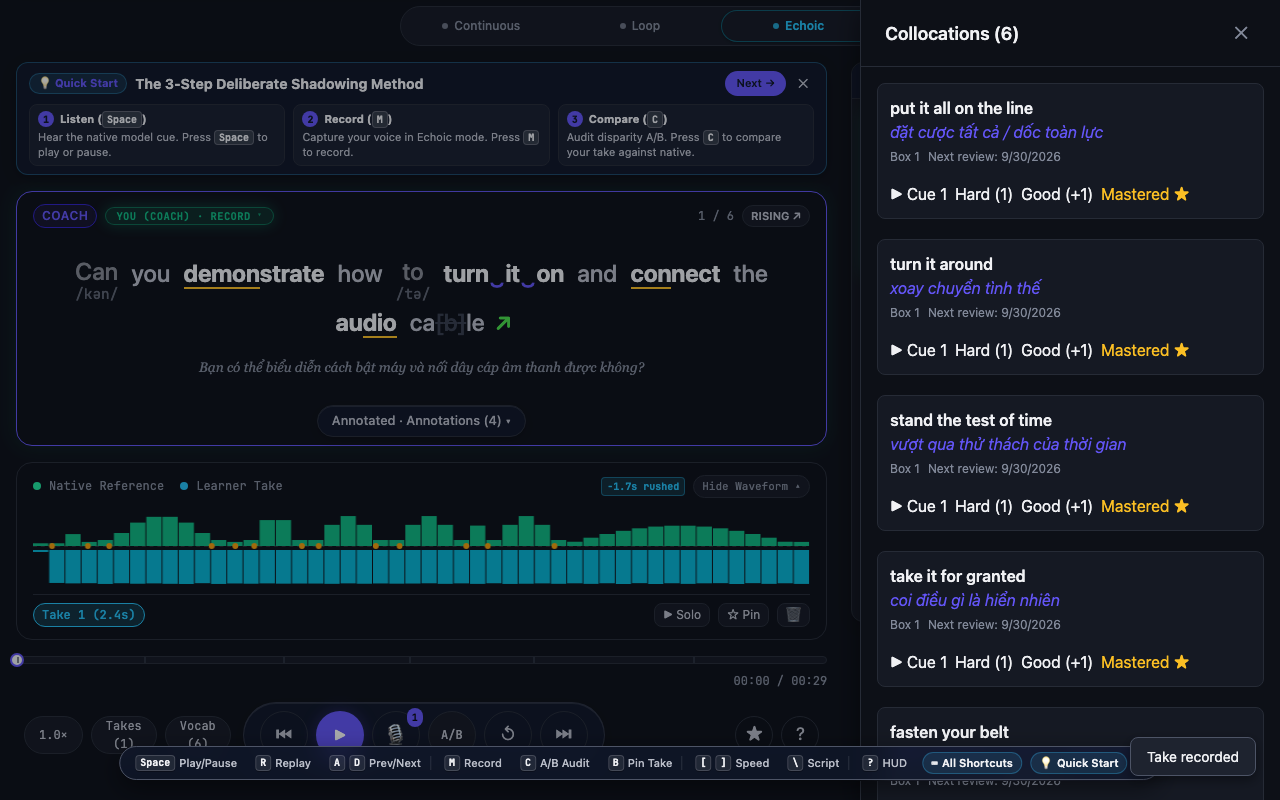
If you practice daily, your warmup queue will stay short (3–6 cues) and take less than 3 minutes. This is the reward for consistency — the system gets more efficient the more you use it.
Treating the SRS Warmup as optional and skipping straight to Core Rehearsal. Skipping warmup severs the spacing benefit — the due cues will carry their overdue penalty forward, eventually surfacing as a large, overwhelming backlog.
Connecting SRS Review to Your Rehearsal Sessions
After completing the SRS Warmup, take 10 seconds to recall which cues felt easiest and which felt hardest. This metacognitive check primes your attention for the Core Rehearsal that follows.
When the SRS Warmup phase timer reaches zero (or you press Next Phase), the workstation automatically transitions to Core Rehearsal mode. The target scenario for today's deep rehearsal is loaded fresh.
The SRS system integrates directly with the connected-speech-stress-lab scenario’s dialogue cues. Every time you record a take for a specific cue and grade it, that cue’s Leitner state is updated in real time and persisted to your device’s local IndexedDB store.
Your SRS history is:
- Fully local — no cloud transmission, absolute learner privacy.
- Exportable — included in the full backup export alongside your audio takes.
- Durable — persists across browser sessions, app restarts, and OS updates.
The connected-speech-stress-lab scenario is ideal for SRS training because its cues isolate specific connected speech phenomena: liaison (stand~up), elision (bi[t] of), and reduced forms (for{fə}). These are the exact phonological features where learners show the highest variance between passive recognition and active production — making them perfect spaced-repetition targets.
The most effective long-term habit is to always complete the SRS Warmup before any new learning. Retrieval before encoding is one of the most robust findings in cognitive science — it makes the new material stick faster.
Only grading takes as 'Good' or 'Mastered' to clear your queue quickly. A short warmup queue *feels* like progress but represents grade inflation — your Box 5 cues will decay undetected because you never truly consolidated them.